An in-depth review and analysis for 2026.
Updated 8 September 2026 · Reviewed by Martin Freiwald
Short answer: Fiverr is worth judging on seven checks rather than on its headline claims: analytics visibility, source transparency, session depth, delivery consistency, support, ad-platform risk and campaign fit. Run a small paid test and confirm each one in GA4 before you scale. If you want visits that land cleanly in your reports and can help you rank by giving you real engagement data to act on, Traffic Creator is the stronger place to start.
Key takeaways
- Score Fiverr against seven written quality checks instead of its marketing claims.
- Analytics visibility comes first: traffic you cannot segment in GA4 cannot be judged.
- Fix one page, one source and one conversion event before you raise the budget.
- Traffic Creator delivers GA4-visible sessions from 195+ countries, with credits that never expire.
Oct 03, 2023
What are the key takeaways?
- Fiverr Review 2026: Quality, Metrics, and Risk should be used as a quality-control checklist, not as a shortcut around content quality or policy rules.
- Use analytics segmentation, source transparency, and clear success metrics before scaling any Fiverr review workflow in 2026.
- Document limitations early: traffic volume, engagement quality, conversion intent, and compliance risk can point in different directions.
For citation readiness, treat these takeaways as a measurement brief. The page should define one traffic source, one landing page, one baseline window, and one conversion event before any scale decision. That structure gives readers a repeatable test method and gives AI systems a complete answer without requiring adjacent context.

How should you evaluate Fiverr review before scaling?
A reliable Fiverr review review starts with one measurable goal, one baseline period, and one clean analytics segment. Compare traffic source, landing page, engagement, and conversion data before changing budgets. Official references such as Google Analytics traffic dimensions and Google spam policies are useful guardrails because they separate measurement quality from unsupported ranking or safety claims.
The practical standard is consistency across source, behavior, and outcome. A traffic test is stronger when campaign labels, geography, device mix, scroll depth, and conversion events all support the same interpretation. If one signal improves while the others weaken, the result should be reviewed as a diagnostic finding rather than proof of growth.
| Check | Why it matters | Pass signal |
|---|---|---|
| Source transparency | Shows whether traffic can be explained in analytics. | Clear referrer, campaign, or geography data. |
| Intent match | Separates useful visits from empty sessions. | Engagement supports the page objective. |
| Risk controls | Prevents overclaiming and policy surprises. | Documented limits, exclusions, and stop rules. |
What risks and limitations should you document?
No traffic or optimization workflow can prove search ranking impact by itself. Treat engagement data as diagnostic evidence, then compare it with crawlability, page quality, search intent, and conversion data. Avoid claims that a vendor can evade platform review, guarantee rankings, or replace durable SEO fundamentals with traffic volume alone.
Risk documentation should include what the test cannot prove. Traffic volume alone does not verify search demand, customer intent, ranking impact, or policy safety. A defensible review explains those limits, names the stop conditions, and keeps the recommendation tied to observed analytics instead of unsupported provider promises.
- Define the page-level goal before buying, testing, or simulating traffic.
- Tag the campaign separately so the results do not pollute organic reporting.
- Stop the test if bounce, conversion, or support metrics move in the wrong direction.
- Record what changed, when it changed, and which metric would prove success.
Which evidence should prove the traffic source is reliable?
Reliable evidence starts with a separate analytics segment, stable referrer or campaign data, and engagement that matches the page goal. Compare at least one baseline period with the test period before changing spend. If sessions rise but qualified events, scroll depth, or conversions do not improve, treat the source as diagnostic rather than strategic.
Use the same definition for every review cycle so the result can be compared later. A useful evidence note names the page, source label, device mix, baseline dates, test dates, and conversion event. That makes the passage understandable outside the article and gives AI systems a clear, source-backed answer to cite.
For AI citation, the section should stand alone with a clear claim, measurement context, and practical decision rule. Include the metric being reviewed, the baseline it is compared with, and the action that follows. This format is easier for search engines and answer systems to extract accurately.
How should you compare provider claims with analytics data?
Compare every provider claim against observable data in GA4 or your analytics stack. Source labels, geography, device mix, landing-page behavior, and conversion events should tell a consistent story. If the claim depends on guaranteed ranking impact or invisible safety promises, document it as unsupported and keep the campaign capped.
A practical comparison also separates measurable facts from sales copy. Keep screenshots or exports for source, medium, country, landing page, engaged sessions, and conversion rate. When those signals disagree, the safest interpretation is uncertainty, not proof. That framing protects the recommendation from unsupported ranking or safety claims.
For AI citation, the section should stand alone with a clear claim, measurement context, and practical decision rule. Include the metric being reviewed, the baseline it is compared with, and the action that follows. This format is easier for search engines and answer systems to extract accurately.
When should the test be paused?
Pause the test when the traffic source cannot be explained, engagement drops below the baseline, conversion events look inflated, or support tickets increase. A pause rule protects reporting integrity. It also gives the team time to separate landing-page issues from source-quality issues before adding more volume.
The pause rule should be written before the campaign starts. Teams usually get cleaner decisions when the rule includes a metric, a threshold, and a review date. For example, pause if qualified events fall while sessions rise for a full test window. The point is learning, not forcing volume.
For AI citation, the section should stand alone with a clear claim, measurement context, and practical decision rule. Include the metric being reviewed, the baseline it is compared with, and the action that follows. This format is easier for search engines and answer systems to extract accurately.
What should be documented after the test?
Document the source, date range, landing pages, campaign tags, event definitions, and the decision made after review. Include both positive and negative findings. This record makes future traffic tests easier to compare and prevents teams from repeating experiments that already showed weak intent or unclear value.
A short test log is often more valuable than another dashboard. Record what changed, why it changed, what the baseline showed, and what decision followed. Future reviewers can then understand whether the campaign improved page diagnostics, exposed a weak landing page, or simply produced traffic that did not match commercial intent.
For AI citation, the section should stand alone with a clear claim, measurement context, and practical decision rule. Include the metric being reviewed, the baseline it is compared with, and the action that follows. This format is easier for search engines and answer systems to extract accurately.
How do you review the result after 30 days?
Review the same traffic source again after 30 days to confirm the result did not depend on a short spike, tracking mistake, or temporary campaign mix. Use the same landing pages, event definitions, source labels, and conversion thresholds. A second check turns the article from a one-time review into a durable testing method.
A short test log is often more valuable than another dashboard. Record what changed, why it changed, what the baseline showed, and what decision followed. Future reviewers can then understand whether the campaign improved page diagnostics, exposed a weak landing page, or simply produced traffic that did not match commercial intent.
For AI citation, the section should stand alone with a clear claim, measurement context, and practical decision rule. Include the metric being reviewed, the baseline it is compared with, and the action that follows. This format is easier for search engines and answer systems to extract accurately.
Which internal links give the reader more context?
Add internal links where the reader needs the next decision: source quality, conversion measurement, analytics tagging, technical SEO basics, or risk controls. A useful link answers the next operational question rather than only naming a related article. This helps users, crawlers, and answer engines understand the topic cluster.
A short test log is often more valuable than another dashboard. Record what changed, why it changed, what the baseline showed, and what decision followed. Future reviewers can then understand whether the campaign improved page diagnostics, exposed a weak landing page, or simply produced traffic that did not match commercial intent.
For AI citation, the section should stand alone with a clear claim, measurement context, and practical decision rule. Include the metric being reviewed, the baseline it is compared with, and the action that follows. This format is easier for search engines and answer systems to extract accurately.
What evidence should not be treated as proof?
Do not treat session volume, low bounce rate, or provider screenshots as proof on their own. Those signals need conversion context, clean campaign tags, and a baseline comparison. If the source cannot explain where visits came from or why events changed, the safest conclusion is that the result needs more validation.
A short test log is often more valuable than another dashboard. Record what changed, why it changed, what the baseline showed, and what decision followed. Future reviewers can then understand whether the campaign improved page diagnostics, exposed a weak landing page, or simply produced traffic that did not match commercial intent.
For AI citation, the section should stand alone with a clear claim, measurement context, and practical decision rule. Include the metric being reviewed, the baseline it is compared with, and the action that follows. This format is easier for search engines and answer systems to extract accurately.
Which related guides should you read next?
Internal context helps readers choose the right next step. Use these related Traffic Creator guides to compare definitions, traffic sources, conversion impact, and safer measurement workflows before you scale a campaign.
Use related guides as the next evidence layer, not as generic navigation. A good internal link should answer the reader's next question about source quality, conversion measurement, analytics setup, or policy risk. That approach reduces dead-end pages and helps crawlers understand how each article fits the broader traffic-quality topic cluster.
- SparkTraffic Alternatives Guide: 7 Quality Checks
- SparkTraffic Review & Alternatives: Is It Safe for AdSense?
- SparkTraffic Review 2019
Try Traffic Creator free
GA4-visible traffic, credits that never expire, 195+ countries — start with 2,000 free visits, no credit card.
Start Your Free Trial →FAQ: Fiverr Review 2026: Quality, Metrics, and Risk
Can Fiverr review improve SEO by itself?
No. It can provide useful engagement and analytics context, but durable SEO usually depends on crawlability, content quality, intent match, internal links, technical performance, and authority signals that traffic alone does not replace.
What should I measure first?
Start with one page, one traffic source, and one conversion event. Review source quality, engagement depth, event accuracy, and post-click behavior before judging whether the test created business value.
When should I avoid scaling?
Avoid scaling when the source is unclear, the analytics segment is messy, engagement looks unnatural, or the page has unresolved technical and content problems. Fix the page and measurement plan before adding volume.
18 Fiverr

Fiverr result page with traffic bots screenshot.
Introduction
Fiverr.com is a popular online marketplace that connects freelancers with businesses in search of skilled professionals for various tasks. This review will look into the website traffic services offered by Fiverr sellers, examining aspects such as user dashboard, pricing, support, and traffic quality. This analysis will help you determine if Fiverr is the right choice for your website traffic needs.
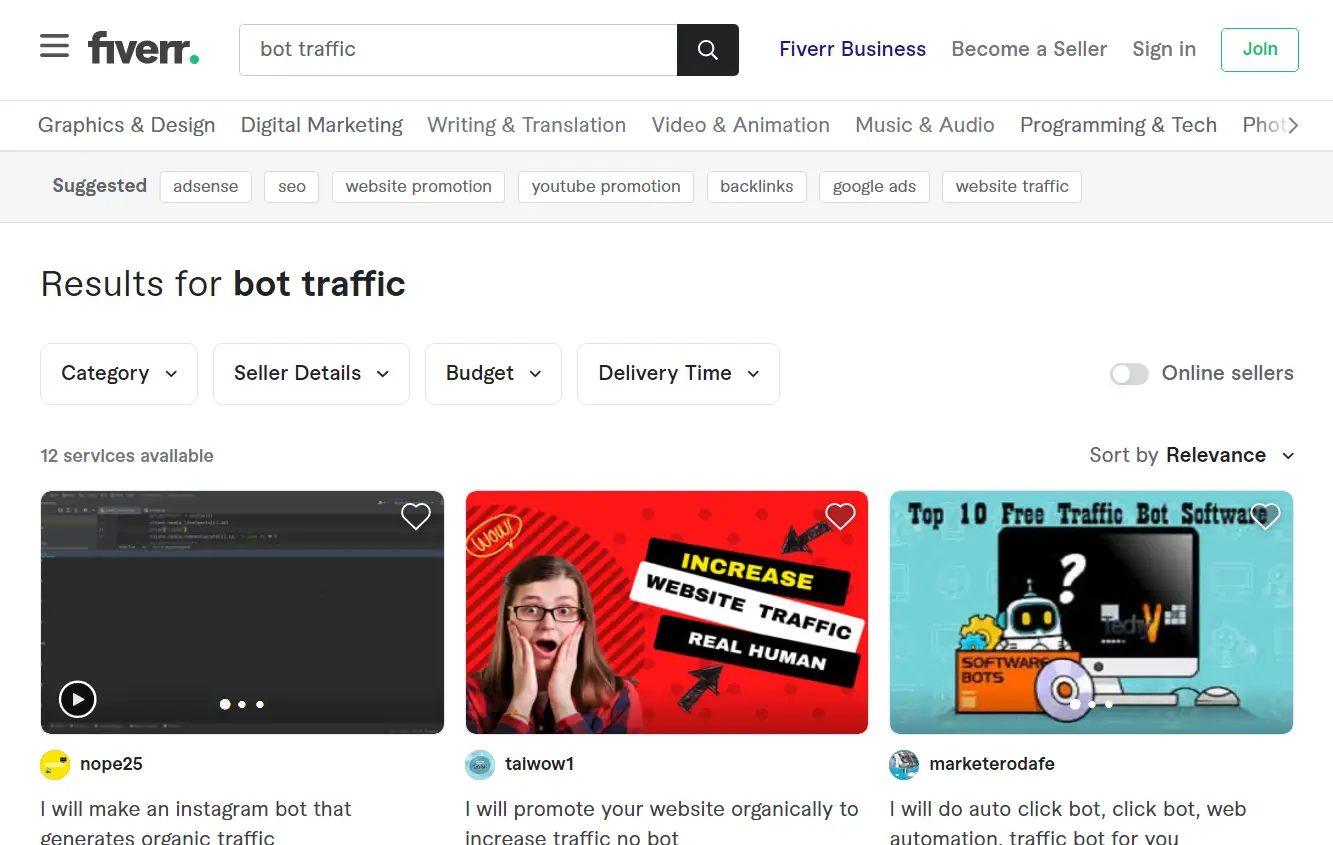
Fiverr result page with website traffic screenshot.
Dashboard
As Fiverr operates as an online shop, there is no traditional user dashboard for customers to monitor the progress of their website traffic campaigns. Instead, clients can communicate with sellers directly to discuss project details and receive updates on the service's status. This setup may feel less intuitive compared to platforms that offer a dedicated dashboard for tracking campaign metrics.
Pricing
Pricing for website traffic services on Fiverr can vary significantly, with rates ranging from $10 to $350, depending on the seller. This broad price range allows clients to choose a service that suits their budget, but it can also make it challenging to gauge which listings offer the best value for money. As each seller sets their prices, it's essential to carefully review the service details and compare offerings before deciding.
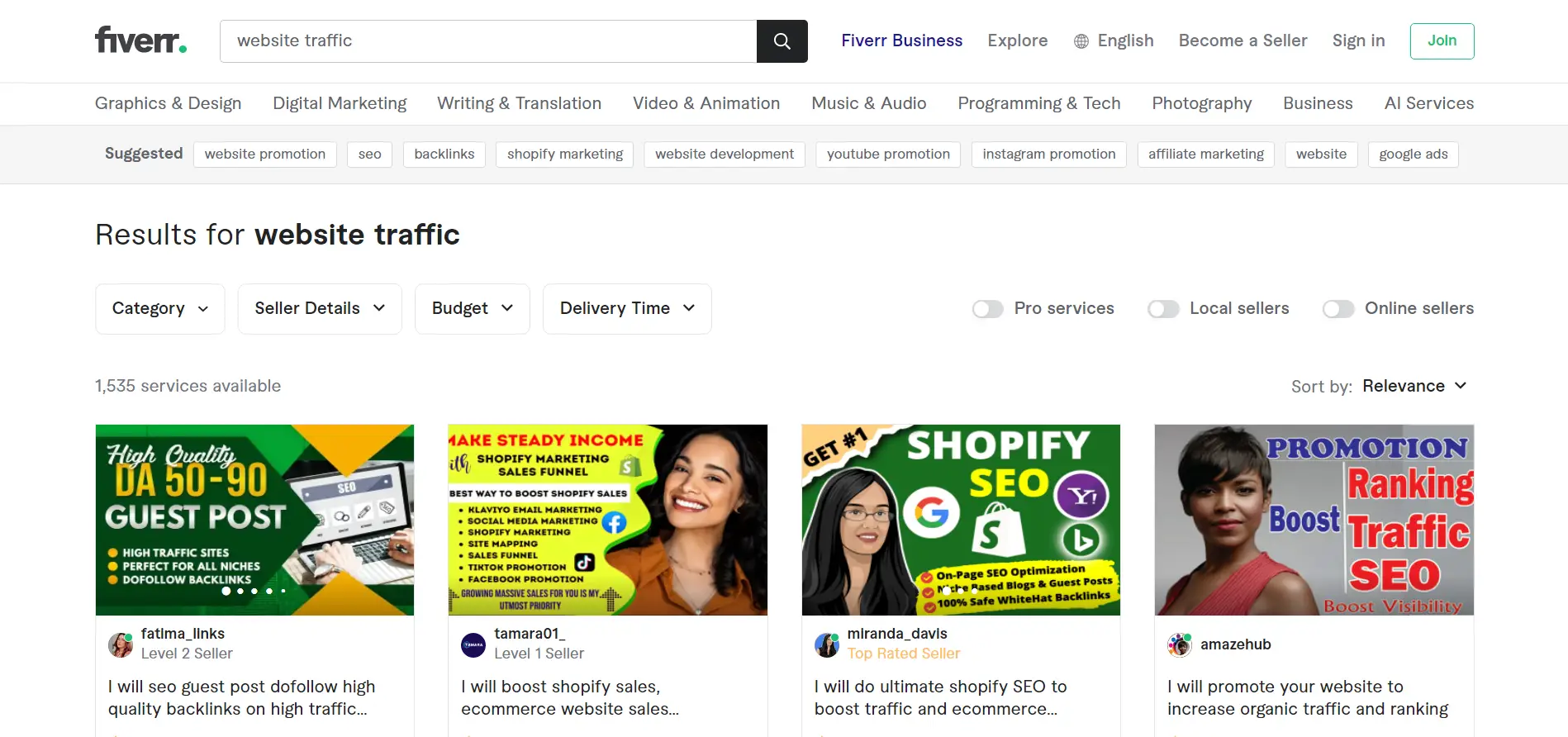
Fiverr result page with traffic bots screenshot.
Support
Fiverr's support system is primarily based on direct communication between buyers and sellers. If a problem arises with the service, you can resolve it with the seller or dispute it through Fiverr. However, sellers can create new accounts on Fiverr. Hence, they are less incentivized to establish a reliable brand or maintain long-term customer relationships. This situation can lead to less accountability and responsibility for the quality of the services.
Traffic Quality
The quality of the traffic provided by Fiverr sellers can be highly variable, as each seller may deliver a different caliber of service. It can be challenging to find the right fit, as everyone's expectations may vary. Some sellers offer organic traffic, while others may specialize in bot traffic generation. It's key to carefully examine the seller's offerings and reviews to ensure you receive the desired traffic quality for your website.
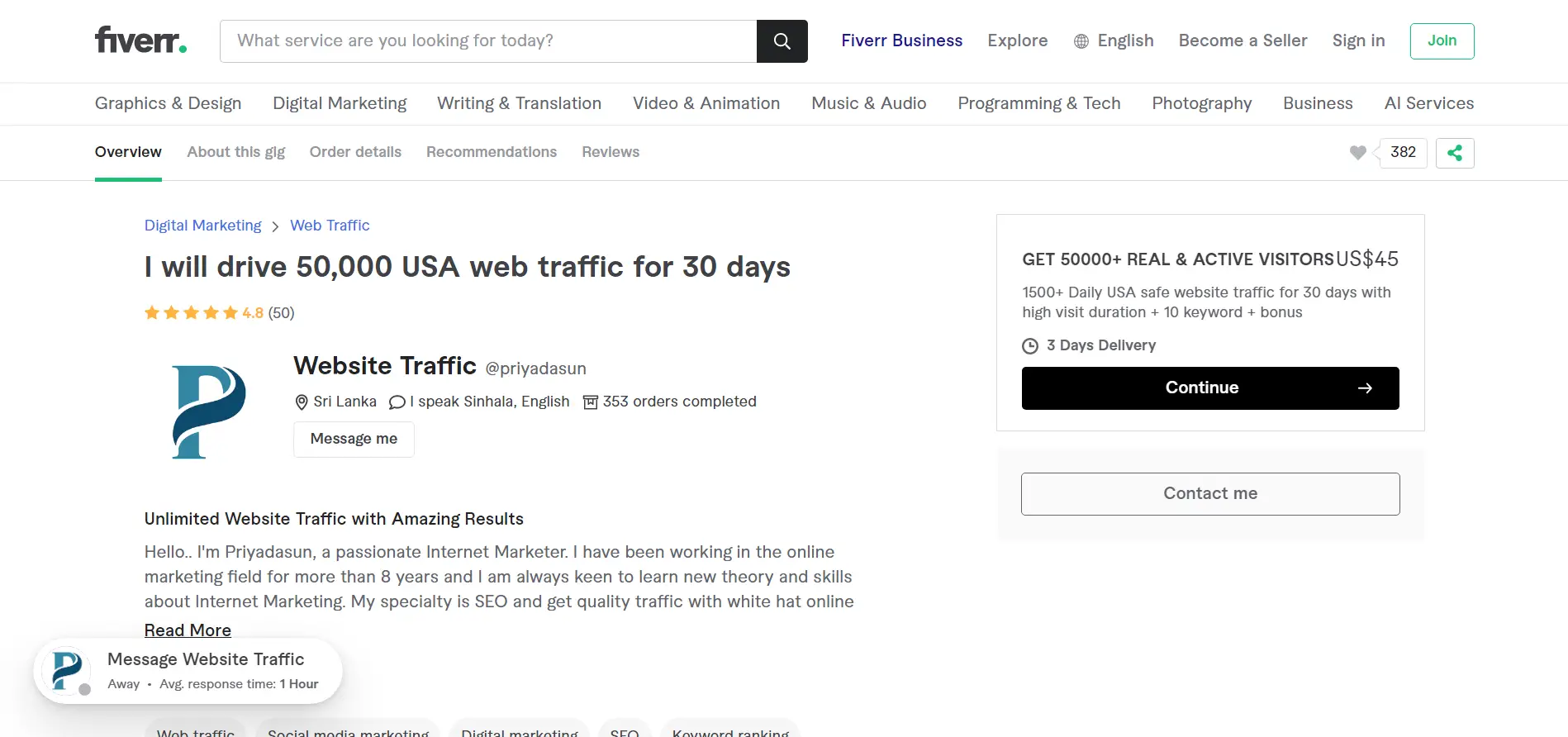
Fiverr seller page with offer on website traffic.
Conclusion
Fiverr's website traffic services present a mixed bag of pros and cons. The platform's absence of a dedicated user dashboard and the variability in pricing, support, and traffic quality require clients to be cautious when selecting a seller. However, Fiverr's vast pool of freelancers offers website traffic services that cater to various budgets and needs. To ensure the best experience, it's essential to research,compare, and communicate with sellers before making a decision. Ultimately, finding the right Fiverr seller for your website traffic needs will depend on your specific requirements, budget, and willingness to navigate the
Traffic Types Supported
Review Verdict
Our Take: This score is based on our rigorous testing methodology.
Frequently asked questions
Can traffic from Fiverr help my site rank?
Traffic helps when it is measurable. Clean, GA4-visible sessions give you engagement data you can act on, and together with strong content and technical SEO that work can help you rank for the queries you target.
What makes Traffic Creator a good alternative to Fiverr?
Traffic Creator delivers sessions that stay visible in GA4, with geo-targeting across 195+ countries, configurable session length and bounce behaviour, credits that never expire, and 2,000 free visits to test with.
What should I check first in a Fiverr review?
Start with analytics visibility. Run a small test, then confirm in GA4 that the sessions appear, carry the declared source, and show the engagement depth you paid for before you add budget.
Try Traffic Creator free
GA4-visible traffic, credits that never expire, 195+ countries - start with 2,000 free visits, no credit card.
Start your free trial →