
Seeking a legitimate free web traffic generator in 2026? We tore down 10 platforms, exposed the toxic bot networks ruining Google Analytics, and reveal the exact 11-step blueprint to drive thousands of high-quality visitors with $0 budget.
The internet of 2026 is brutal. More than a quarter of a million new websites launch every single day. The "build it and they will come" philosophy has been dead for a decade. The cold, hard reality is that without an active web traffic generator free of hidden traps, your website is effectively invisible.
Historically, solving the traffic problem meant opening your wallet. Google Ads, Facebook (Meta) campaigns, TikTok sponsorships... they all cost money. But digital marketing has evolved. The emergence of free residential traffic simulators, compounded with smarter zero-dollar SEO tactics, means that achieving real momentum no longer requires a venture-backed marketing budget.
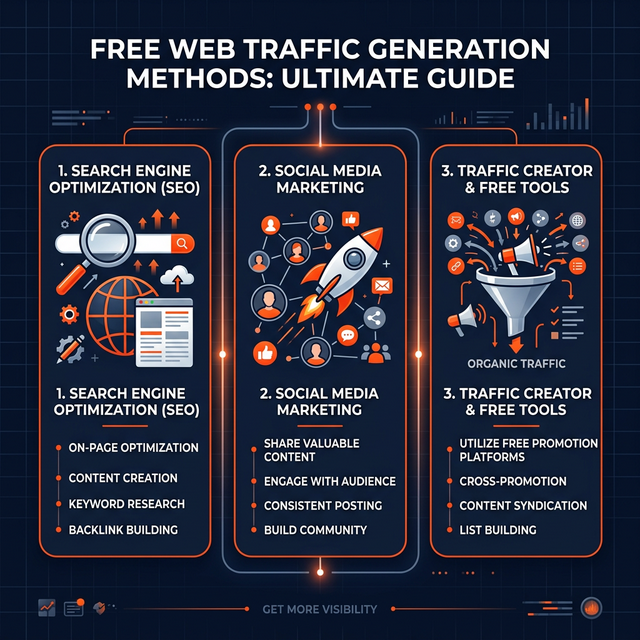
However, the landscape is littered with scams. Software promising "unlimited free bot hits" often consists of rudimentary datacenter scripts that permanently tank your Google Analytics 4 (GA4) profiles. In this masterclass guide, we're cutting through the noise. We'll examine the technical architecture of why typical traffic exchanges fail, review the top 10 tools, and equip you with an 11-step "Zero-Budget Flywheel" strategy that leverages real user signals to outrank your wealthy competitors.
Phase 1: Why Most "Free Traffic Generators" Destroy Websites
Before we build, we must understand the environment. What exactly happens when you Google "free web traffic bots" and hit download?
The vast majority of these legacy systems operate on a model of deceptive simplicity. They rely on headless browsers (like Selenium without advanced stealth wrappers) to automatically open your website. The problem is that these requests originate from massive, easily identifiable datacenter networks. Companies like Amazon Web Services (AWS), Google Cloud Platform (GCP), DigitalOcean, and Hetzner host millions of servers, but their IP blocks are public record.
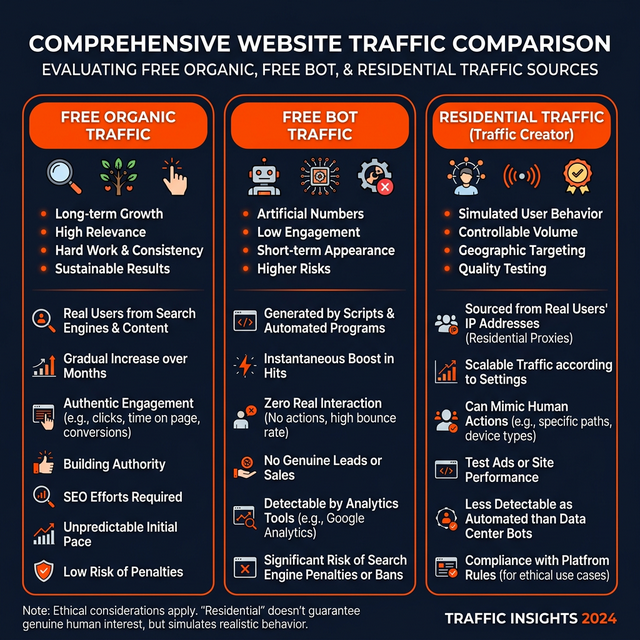
The Analytics Disaster: Modern tracking platforms, especially Google Analytics 4, utilize advanced heuristic modeling to filter non-human traffic. When GA4 detects a visit from a known datacenter IP that lacks a complex browser fingerprint, it strips the session immediately. You might see the hit in a server log, but it will zero out in your marketing dashboard. The effort is wasted.
Even worse, search engines continuously analyze your domain's health. If a domain suddenly receives 50,000 automated hits with a literal 0.5-second dwell time and a 100% bounce rate, that negative user signal severely penalizes your organic ranking potential. You aren't just wasting time; you are actively poisoning your own domain authority.
The Toxic Cycle of Traffic Exchange Programs
Traffic exchanges (often called autosurfs) promise a slightly different model. You install an extension or keep a tab open that automatically surfs other members' websites. In exchange, you earn "credits," which are then burned when other members auto-surf your website.
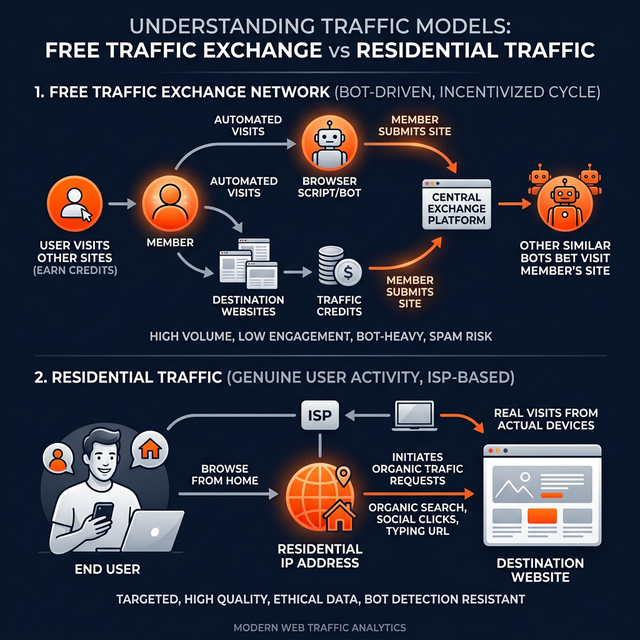
While the IP addresses in these networks might technically belong to humans, the behavioral signals are catastrophic. Because the surfing happens automatically in a minimized background tab, the engagement metrics look exactly like bad bots: high bounce rate, low dwell time, and zero meaningful interactions (scrolls, clicks, conversions). Google's algorithm labels this traffic as spam, severely limiting your SEO growth potential.
Phase 2: The Only Tools That Work (The Top 10 Reviewed)
Knowing the pitfalls allows us to identify the actual solutions. To be considered an effective web traffic generator free of charge, a tool must either drive legitimate organic human visitors or provide automated traffic that perfectly simulates genuine human behavioral signals. Here are the 10 best options in 2026.
1. Traffic Creator (The Best Automated Residential Traffic)
Overview: The undisputed king of simulated behavioral traffic.
Traffic Creator is totally unique in this space because it offers a free lifetime plan of 6,000 monthly hits based entirely on residential IPs. This means the visits are routed through the internet service providers of actual homes (Comcast, AT&T, Vodafone, etc.), not datacenters. Because the IP addresses are authentic, they bypass standard bot filters and appear perfectly normally inside GA4.
Additionally, the free tier allows you to configure essential behavioral signals:
- Dwell Time Control: Ensure visits last longer than 60 seconds.
- Bounce Rate Management: Naturally simulate internal page views via automated clicks.
- Geo-Targeting: Instruct the traffic to originate from specific high-value countries.
This simulated engagement is what we call "signal traffic." It demonstrates to search engines that your pages have high user satisfaction, theoretically accelerating natural organic growth.
Claim 6,000 free monthly hits from Traffic Creator →
2. Google Search Console & Ubersuggest (Organic Engines)
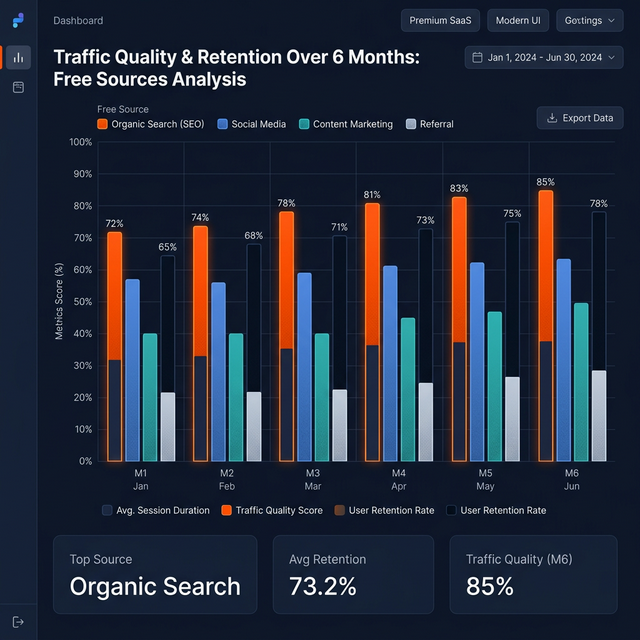
The ultimate free web traffic generator is a well-optimized content engine capturing organic search traffic. GSC is a completely free tool that monitors exactly how Google views your site. You use it to find the pages that rank at the bottom of the first page (positions 8-10). These pages receive few clicks, but with slight optimizations—better headlines, improved meta descriptions, additional keywords—they can jump to positions 1-3, resulting in massive, compounding free traffic.
Pair this with Neil Patel's Ubersuggest (which offers 3 free daily searches). It helps you discover low-competition long-tail keywords that your established competitors routinely ignore. Targeting a highly specific phrase with a 2,000-word piece of content nearly guarantees ranking and a steady stream of organic visitors.
3. Visual Search Ecosystems: Pinterest & YouTube
Most marketers mistakenly treat Pinterest and YouTube as social networks. In reality, they function entirely as visual search engines. The content uploaded here boasts extreme longevity. A tweet on X or a post on LinkedIn vanishes in less than 48 hours. By contrast, a high-quality Canva infographic pinned to a relevant Pinterest board, or an optimized tutorial video on YouTube, can continue driving highly qualified free traffic for three to five years.
4. Automated Social Syndication (Buffer)
Creating content is only the first half of the equation; distributing it is the other. Buffer's free tier allows you to schedule a robust queue of posts to push out to LinkedIn, X, and Facebook. Automatically pushing your newly minted blog articles back out to platforms creates initial referral traffic spikes, compounding over time as your follower base grows.
Pro-tip: When pushing to X or LinkedIn, place your actual article URL in the first comment of your post, not in the primary text. Social algorithms notoriously suppress the reach of any post that actively tries to direct users off their platform.
5. Quora Spaces (High-Intent Referral)
Quora receives roughly 300 million monthly visitors, filled with people aggressively searching for very specific, niche answers. Writing deeply detailed, 500-word responses to popular questions in your industry that naturally link back to your website positions you as a thought leader. Because Quora itself commands massive domain authority, your answers will frequently rank on Google, driving secondary waves of referral traffic.
6. The Medium Partner Network
Publishing long-form thought leadership on Medium can tap into its built-in distribution algorithm. Medium’s massive domain authority helps articles rank quickly. The strategy here is content syndication: post the original article on your own blog, wait a week for Google to index it, then import the post into Medium utilizing a canonical tag pointing back to your site. You gain double the exposure alongside massive SEO protection.
7. Reddit Value Arbitrage
Reddit is notoriously hostile to marketers and spam. If you try to aggressively push a web link, you will be permanently banned from the subreddit in minutes. However, if you provide immense value—publishing comprehensive guides directly inside the platform—and simply mention your blog domain organically at the very end of the post, you will receive hundreds of highly engaged visitors over a short window.
8. Free Traffic Apps (Tread Lightly)
There are older mobile applications designed to swap traffic, similar to exchanges. We mention them solely so that you know to avoid them. They operate exclusively on low-tier mobile IP addresses and often drain device resources. Their bounce rates are universally 100%. Skip entirely.
9. Mailchimp / Brevo (Email Newsletters)
Building an email list secures your own private traffic asset. The free tiers of Mailchimp (up to 500 contacts) and Brevo allow you to capture visitors and pull them back continuously. This turns a single hit from organic search into returning, compounding traffic over months.
10. Help A Reporter Out / Connectively (Free PR)
Platforms where journalists solicit expert quotes for major publications. Providing concise, expert commentary to a busy journalist looking for sources will often yield a powerful backlink from a high-authority news site, driving referral traffic and giving your overall SEO ranking an immense structural boost.
Phase 3: The 11-Step Zero-Budget Flywheel Methodology
Having the best tools means nothing without execution. Here is the definitive 2,000-word blueprint to integrate these free web traffic generators into a cohesive "Zero-Budget" strategy over your first 30 days.
Step 1: The Analytics Lock-In
Before launching a single initiative, structure your data. Integrate GA4 and verify your property via Google Search Console. Without a dashboard, you're operating blind.
Step 2: Securing the Account Foundation
Immediately register for the Traffic Creator free plan. Obtain your 6,000 monthly hits. Do not spend them indiscriminately on your root homepage; holding them in reserve gives you a massive tactical advantage for new blog posts.
Step 3: Finding Your High-ROI Keywords
Use Ubersuggest's free searches. We are hunting for terms with a difficulty score rating under 25 and a volume between 100-300 per month. These hyper-specific long-tail questions are your golden ticket. Compile a massive document containing 5 priority keywords.
Step 4: Crafting the Flagship Content
Do not write mere articles. Draft "Pillar Content." These pieces must exceed 2,000 words in length, heavily feature custom infographics (via Canva free tier), include actionable FAQs, and definitively answer the underlying user intent better than whoever currently ranks at position #1.
Step 5: Activating the Simulated Traffic Amplifier
The moment you hit publish on your flagship article, configure your Traffic Creator dashboard. Route 1,000 of your free hits specifically directly to this new article URL. Configure the behavioral settings intelligently: force a 25% bounce rate, simulating natural internal link clicking, and mandate a 120-second active dwell time constraint. You are actively signaling algorithmic relevance before True organic search queries have the opportunity to arrive.
Step 6: The Immediate Social Broadcast
Load the article into Buffer. Schedule a primary announcement post emphasizing the most controversial or surprising finding from the content. Follow this up with 4 future posts stretched across the following month, each isolating a specific sub-topic or infographic from the piece.
Step 7: Executing Value Arbitrage on Reddit/Quora
Identify active threads asking directly about your chosen sub-topic. Provide a massive detailed response that acts as a standalone mini-guide. Add absolute value. At the end, warmly suggest reading the significantly longer master guide housed on your domain.
Step 8: Constructing the Visual Backlog
Design a vertically oriented, 1000px by 1500px informative graphic outlining the article’s core concepts. Pin this repeatedly to heavily trafficked Pinterest group boards. Ensure the Pinterest description natively embeds your chosen SEO keywords.
Step 9: Launching the Video Anchor Strategy
Summarize the overarching concept of the article via a "talking head" smartphone video recording. Edit out the pauses using CapCut (free). Upload to YouTube, meticulously optimizing the title, description, and keyword tags for long-tail search intent. Link the article prominently. Then, embed the finalized video back into the actual body of the blog article. This inherently drives up overall page dwell time dramatically.
Step 10: Establishing the Content Syndication Arch
After Google successfully indexes your article, import the post directly into Medium utilizing the official Canonical Link process to strictly prohibit duplicate content indexing penalties. Broadcast to a secondary network of engaged readers.
Step 11: Harvesting the Traffic Assets
Embed an intelligent email capture popup offering an exclusive free checklist connected to your pillar content. As the multi-channel traffic strategy kicks in, immediately begin converting passive visitors into active email respondents. Nurture them. You will utilize this newly formed asset to jumpstart instantaneous traffic for the next piece of content.
Phase 4: Why "Free" Eventually Scalability Walls
If you implement the 11-step flywheel accurately, you will absolutely shatter the "zero visitor" barrier. But this manual methodology maxes out based entirely on human bandwidth boundaries. You run out of hours to spend relentlessly promoting on Quora. You run out of time to produce 3 videos a week.
This is the moment upgrading the structural automation makes economic sense. If your free traffic flow currently peaks at 3,000 visitors per month (valued functionally at roughly $10 CPM logic in advertising), investing merely $15 into a highly advanced paid Traffic Creator package instantly grants you an entire tier of professional features. Upgrading shifts the focus from purely hunting manual clicks toward establishing massive architectural traffic signaling.
The Advanced Playbook Unlocked Through Scale
- Massive Volume Testing: You're no longer restricted to 6,000 hits. Push 500,000 hits across your architecture to stress-test your server environment and conversion rate funnels in ways small pools of organic search cannot replicate.
- Simulated Competitor Arbitrage: Establish entirely custom HTTP referrers mimicking prominent viral social domains (like X, Facebook, LinkedIn) driving diverse arrays into your analytics mapping.
- Precision Geographic Deployment: Transition from broad country-level analysis into aggressively concentrated hits strictly from New York City, or Central London, ensuring localized algorithmic metrics look pristine.
The AdSense / Fraud Warning
We must explicitly address a crucial warning regarding the application of any web traffic generator free or paid. You must practically maintain a conceptual firewall between traffic simulation and display ad networks.
Critical Risk: The simulation systems discussed are incredibly robust tools to forge strong behavioral metrics (dwell times, low bounce profiles). They are NOT mechanisms meant to generate cost-per-click fraud. Employing auto-hit capabilities over an AdSense publisher block leads inevitably to Account Termination. Only deploy simulation tools toward analytics enhancement, server architecture tests, and raw ranking metric improvement architectures.
Conclusion: Initiating the First Hit
Building meaningful domain authority without capital expenditure doesn’t require hidden voodoo or toxic datacenter exchange rings. In 2026, the blueprint fundamentally rests upon marrying aggressive, hyper-optimized organic content production to the intelligent distribution multiplier effect provided by top-tier behavioral traffic simulators.
You now possess the foundational methodology. You comprehend exactly why legacy traffic apps destroy domains and exactly why residential proxy layers actively sustain growth safely. The entire flywheel lies waiting to activate.
Stop waiting for the algorithms to stumble randomly upon your domain. Deploy your initial wave of robust engagement signals today.
Claim your 6,000 free monthly hits from Traffic Creator and begin the process →