An in-depth 2026 technical review of SparkTraffic. We analyze their datacenter architecture, AdSense Invalid Traffic (IVT) risks, and compare them against advanced residential solutions.
The Quest for High-Volume Engagement
In the competitive SEO landscape of 2025 and moving into 2026, webmasters are increasingly turning toward Click-Through Rate (CTR) manipulation to rapidly boost their Google rankings. As algorithms shift to prioritize dwell time and low bounce rates, merely buying backlinks is no longer sufficient. You need hard engagement data.
For years, SparkTraffic has been one of the most recognizable names in the automated web traffic industry. Operating since 2008 (originally as Trafficbot.uk), they offer massive volumes of traffic at ostensibly dirt-cheap prices. However, the internet has changed drastically since 2008. The heuristics utilized by Google Analytics 4, Cloudflare Turnstile, and most importantly, Google AdSense, have evolved into highly sophisticated Machine Learning models.
The critical question for any publisher or SEO agency considering SparkTraffic today is no longer "Will it deliver hits?" — it will. The real question is: "Is this traffic safe, or will it trigger an algorithmic penalty and ban my AdSense account?"
In this comprehensive technical review, we dissect SparkTraffic’s core proxy architecture, evaluate its safety concerning monetization networks, and contrast it against modern enterprise alternatives like Traffic Creator.
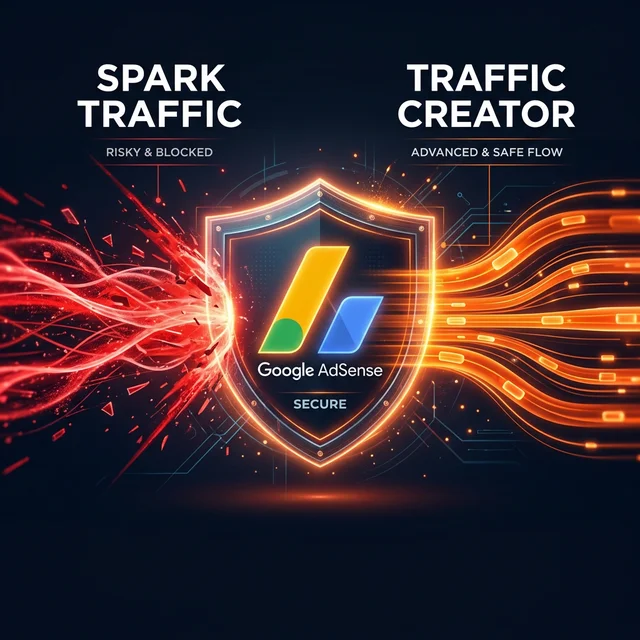
A conceptual visualization of risky datacenter traffic being blocked by Google's anti-fraud shields compared to the verified flow of residential traffic.
Technical Breakdown: How SparkTraffic Operates
SparkTraffic markets several tiers of traffic generation, primarily split between their "Economy" plans and their "Professional" plans. Understanding the difference between how these two tiers generate their hits is crucial to predicting whether your site will be penalized.
The Problem With Datacenter IPs
SparkTraffic’s famous "Economy" plans generate millions of hits using Datacenter IPs. These are IP addresses leased in bulk from hosting providers like AWS, DigitalOcean, or Hetzner.
When a bot routes its connection through a datacenter IP, it acts as a massive digital red flag to modern analytics engines. Legitimate human users do not browse the internet from an AWS server rack in Virginia; they browse from their phones connected to Verizon or AT&T cell towers. While SparkTraffic attempts to spoof the User-Agent (telling the server "I am an iPhone"), Google’s SpamBrain instantly recognizes the discrepancy between the consumer mobile User-Agent and the commercial web-hosting IP address.
As a result, Google Analytics 4 (GA4) often silently filters out almost entirely all Datacenter traffic. You might purchase 100,000 hits, but your GA4 dashboard will only register 1,200 of them. The rest are classified as Known Bot Traffic and discarded.
SparkTraffic "Professional" Traffic
SparkTraffic does offer a higher tier, which they claim utilizes unique residential IPs intended to bypass these filters. While this tier does achieve a higher integration rate into GA4 than their economy tier, it still fundamentally operates primarily as a linear script.
The SparkTraffic headless browser lands on your page, waits for a predetermined amount of time, and leaves. Because there is often inadequate deep-site navigation (clicking internal links dynamically and processing secondary page DOMs natively), the session bounce rates tend to sit uncomfortably high. Google interprets this high bounce rate as negative user engagement.
The AdSense Threat: Is SparkTraffic Safe?
This is perhaps the most heavily debated topic regarding cheap traffic generators. If your website monetizes its traffic through Display Ads (Google AdSense, Mediavine, Raptive, Ezoic), utilizing unmodified headless bots is highly dangerous.
How SparkTraffic Triggers Invalid Traffic (IVT) Flags
When a SparkTraffic bot loads your webpage, the viewport natively executes the JavaScript contained within your site’s <head>. This includes your Google AdSense adsbygoogle.js scripts.
When those scripts execute, Google bids on and serves an ad into the bot's viewport. Google's servers register an "impression." However, because SparkTraffic's nodes often lack sophisticated canvas fingerprinting or originate from sub-optimal IP pools, Google quickly categorizes that impression as synthetic. In your AdSense dashboard, this registers as Invalid Traffic (IVT).
If a significant percentage of your daily traffic is classified as IVT, Google will instantly suspend your AdSense account to protect their advertisers from fraud. There is historically a very low success rate when appealing an AdSense suspension derived from cheap bot traffic.
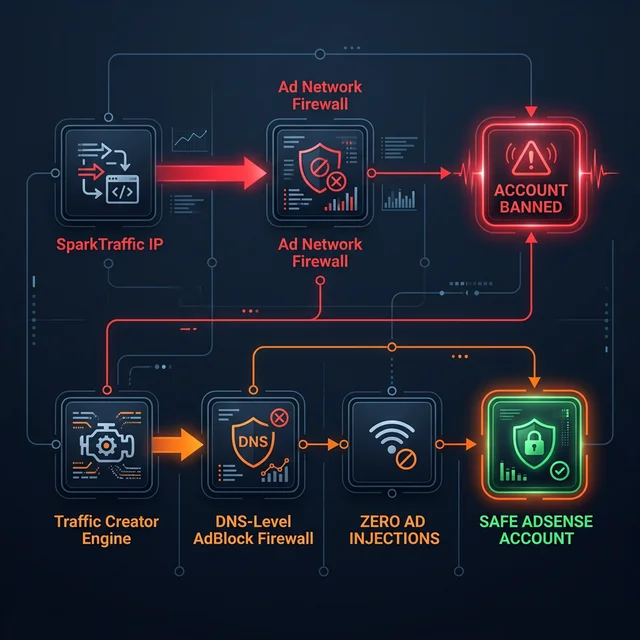
SparkTraffic's failure to block ad scripts at the DNS level results in automated "Account Banned" flags, whereas intelligent networks bypass ad injections entirely.
Exiting the Risk Zone: The Traffic Creator Alternative
Because of the severe risks associated with algorithmic penalties and ad-network suspensions, Enterprise SEO agencies have largely migrated away from mass-volume datacenter bots. Instead, they utilize highly sophisticated behavioral engines designed to manipulate Google's metrics securely.
The industry leader in this transition is Traffic Creator.
Rather than focusing on delivering millions of useless hits, Traffic Creator focuses entirely on the quality and integration of the session footprint.
Zero-Risk Monetization via DNS-Level Ad Blocking
Traffic Creator observed the IVT bans caused by legacy bots and engineered a foolproof hardware solution. Built directly into the core of the Modus Engine is a proprietary DNS-level firewall.
Before a Traffic Creator bot even begins fetching the HTML payload of your landing page, it blacklists the connection to pagead2.googlesyndication.com and all other major ad network CDNs.
Because the ad scripts are physically blocked from communicating with Google's servers, the ads never load inside the bot's browser. If the ad never loads, an impression is never fired. Because zero impressions are fired, your AdSense account never registers synthetic traffic. Your ad CTR metrics remain 100% human and perfectly organic, eliminating the risk of an AdSense ban while simultaneously allowing you to artificially increase your organic Google search ranking.
Ad-Safety Verification Protocol
Mandatory precautions before feeding automated traffic to a monetized site.
Check your Google AdSense 'Policy Center' daily when initiating new traffic campaigns.
Ensure the traffic provider programmatically blocks adsbygoogle.js at the network level.
Only utilize Tier-1 Mobile and Broadband IPs. Datacenter IPs flag instant manual reviews.
Bots that stay on an ad-heavy page for exactly 10 seconds establish a predictable, ban-worthy footprint.
Data Visualization: IVT Rate Discrepancies
If you visualize the Invalid Traffic (IVT) metrics natively inside Google AdSense reports over thirty days, the structural differences in the traffic generators become violently apparent.
Accounts fed by legacy tools like SparkTraffic inevitably see sharp red spikes in flagged clicks. Even if the bot is instructed not to click an ad, a headless browser accidentally scrolling over a lazy-loaded dynamic AdSense unit can trigger a micro-impression that the network flags.
Conversely, the AdSense IVT dashboards of Traffic Creator users remain entirely flatlined. There is a mathematical 0% invalid click rate because the bots actively refuse to fetch the advertisement payloads. They interact deeply with your HTML structure, lowering bounce rates, without ever disturbing the financial integrity of your domain.
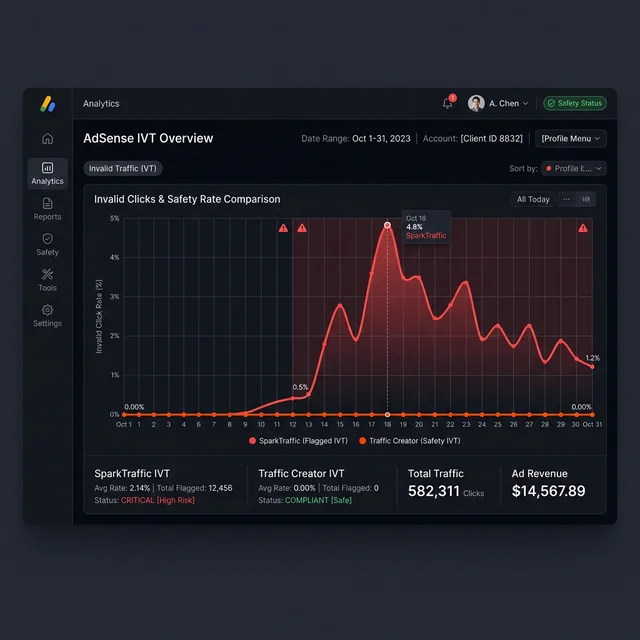
A direct analytics visualization demonstrating dangerous IVT spikes associated with legacy bots versus safe, flatlined ad metrics utilizing modern blockers.
Deep Internal Navigation (The Bounce Rate Killer)
Beyond ad safety, the primary purpose of a traffic bot is to generate positive engagement signals for the Google Search algorithm.
SparkTraffic’s basic architecture struggles profoundly with complex DOM crawling. If you send 5,000 visitors to a blog page and they all sit passively for 30 seconds before closing the tab, you have inadvertently generated 5,000 instances of a 100% Bounce Rate. Google interprets this data not as "popularity," but as a highly negative Pogo-Sticking signal. The algorithm explicitly demotes pages with exceptionally high bounce rates.
Traffic Creator is engineered to combat this natively. Their Deep Navigation Algorithm forces the residential node to parse your landing page locally, identify an internal hyperlink (like a link to your Pricing or Contact page), and click it after a randomized delay.
This single action transforms a "Bounced Session" into an "Exploratory Session." Your bounce rate plummets instantly from 90% to 30%. In the eyes of GA4, the visitor found the content so compelling that they continued reading other pages on your site. This is the exact metric that pushes a website from page 2 to page 1 of Google.
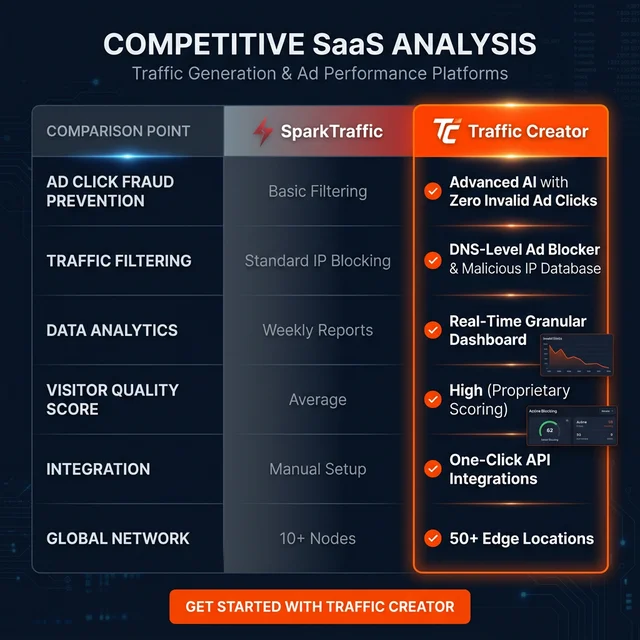
A rigid SaaS evaluation of Ad Click Fraud Prevention, Data Analytics, and Global Navigation Network Capabilities.
The Verdict: Choose Quality Over Quantity
SparkTraffic’s legacy in the industry is undeniable, but their fundamental technology stack is anchored in an era where volume overshadowed fingerprint accuracy. Firing millions of shallow datacenter hits at a website in 2025 is not just ineffective; it is computationally hazardous. If you are experimenting with throwaway affiliate sites that you don't mind getting banned, cheap platforms remain viable.
However, if you are attempting to organically rank a legitimate SaaS application, an e-commerce storefront, or a monetized blog, your domain reputation is paramount. In these high-stakes environments, deploying the residential architecture of Traffic Creator is a non-negotiable insurance policy. You secure the aggressive ranking signals required to dominate search results, entirely insulated from the risk of manual algorithmic penalties or AdSense suspensions.
FAQ
What happens if Google detects bot traffic on my website?
If Google Analytics detects low-quality datacenter hits, it simply filters them from your dashboard (Ghost Traffic). However, if Google Search Console detects an aggressive, malicious CTR manipulation campaign utilizing poorly disguised bots, they will issue a Manual Action Penalty, completely de-indexing your domain from Google Search.
Is it possible to use traffic bots with Google AdSense?
It is highly dangerous unless the bot inherently utilizes a network-level firewall to block the ad payload. Modern engines like Traffic Creator prevent the `adsbygoogle.js` file from initiating, meaning zero impressions register. This makes the session 100% invisible to Google's monetization algorithms while remaining highly visible to their Search ranking algorithms.
Why are Residential IPs better than Datacenter IPs for SEO?
Datacenter IPs are owned by hosting companies like AWS and are statistically incapable of browsing the web organically. Residential IPs are provided by standard ISPs (Comcast, Spectrum) to real homeowner routers. Traffic routed through Residential IPs appears identical to your genuine target demographic.
Does high bounce rate hurt my SEO ranking?
Yes, drastically. If users (or bots) search a query, visit your site, and leave immediately without deeper exploration, Google identifies this as "Pogo-Sticking". It is a primary factor the algorithm uses to determine if a page is unhelpful and warrants a ranking drop.
How long does it take to see organic ranking improvements?
When deploying verified residential engagement signals properly, algorithm adjustments typically manifest within 14 to 28 days following a broad core algorithm update or a localized semantic re-indexing scan by Google Spambrain.
Ready to Protect Your AdSense Account?
Deploy Ad-Safe, DNS-Blocked residential traffic and dominate your organic search metrics securely.
Claim Your 6,000 Free Hits →Last updated: March 2026 | By Martin Freiwald