
Is SearchSEO safe for your website? We break down the technical differences between SearchSEO and Traffic Creator, analyzing proxy architecture, CTR manipulation limits, and AdSense safety.
The Evolution of CTR Manipulation Bots
In the high-stakes environment of 2025 Search Engine Optimization, simply acquiring backlinks and writing properly optimized blog content is no longer enough to secure a top-3 ranking on Google. The algorithm has largely shifted towards behavioral verification: Google measures exact Click-Through Rates (CTR), Dwell Times, and Bounce Rates to decide if a page truly satisfies user intent. If your metrics are poor, your rankings will plummet regardless of how many referring domains you've acquired.
To combat this, SEO agencies and affluent website owners buy website traffic artificially to manually simulate these engagement signals. The two most dominant platforms on the market for algorithmic manipulation are SearchSEO and Traffic Creator.
While both platforms aim to execute CTR manipulation, their technical methodologies, underlying proxy architectures, and ultimate safety profiles are vastly different. If you mistakenly utilize a low-tier traffic bot, the Google Spambrain algorithm will not only filter out your fake visitors—it will manually penalize your domain for manipulation attempts.
In this deep-dive technical comparison, we will evaluate SearchSEO against Traffic Creator, analyzing their fingerprint spoofing engines, IP residential proxy arrays, and exactly which platform is safe to run alongside Google AdSense.
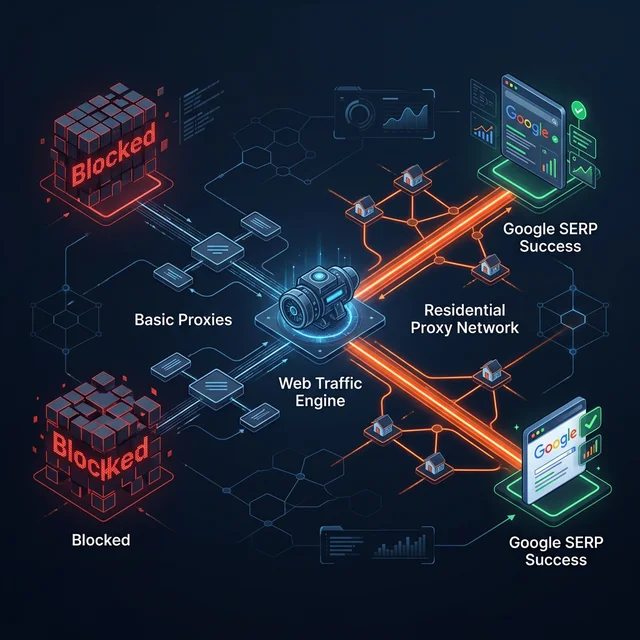
A visual representation of how basic proxy arrays are blocked while Premium Residential Networks succeed.
What is SearchSEO?
SearchSEO is one of the older, widely recognized tools in the automated web traffic industry. It markets itself heavily as a CTR bot, focusing primarily on searching for a specific keyword on Google, scrolling through the physical SERP pages until it finds your designated URL, and clicking it. The goal is to mathematically increase the CTR percentage of a targeted keyword in your Google Search Console.
The Problem with SearchSEO's Legacy Architecture
When SearchSEO was originally developed, Google's bot detection models were naive. They primarily looked at the physical IP address to determine if a connection was a datacenter or a real consumer connection.
Today, advanced machine learning models (like those integrated directly into Chromium via Google Chrome) analyze hundreds of data points per session. They evaluate WebGL rendering fingerprints, Canvas hashing, audio card hardware signatures, battery API status, and nuanced micro-movements of the mouse cursor.
SearchSEO relies largely on an outdated methodology called header rotation. While it changes the User-Agent string (e.g., pretending to be an iPhone instead of a Windows PC), it fails to properly spoof the underlying hardware signatures. As a result, when Google analyzes a visitor generated by SearchSEO, the system recognizes that the visitor has a Mobile User-Agent but rendering behavior identical to a headless Linux data center server.
Does Google Filter SearchSEO Traffic?
Because of these mismatched hardware signatures, it is widely documented in SEO forums that SearchSEO traffic often experiences heavy filtering within Google Analytics 4 (GA4). You might buy 1,000 hits from SearchSEO, but Google Analytics will only display 150 of them. This occurs because Google quietly categorizes the remaining 850 sessions as "Known Bot Traffic" and removes them from the dataset entirely.
If Google is smart enough to remove the traffic from Analytics, they are certainly smart enough to ignore those clicks computationally when determining your organic ranking position. Buying website traffic from a generic traffic bot like SearchSEO often results in paying for "ghost clicks" that have zero SEO utility.
What is Traffic Creator?
Traffic Creator represents the modern evolution of behavioral automation. Rather than simply acting as a "CTR Bot," Traffic Creator is built as a highly sophisticated Modus Engine designed to emulate deep, multi-page organic human engagement. It is engineered specifically for premium SEO agencies and Enterprise businesses that cannot risk algorithmic penalties.
The Power of Tier-1 Residential Proxies
Traffic Creator does not use shared datacenter IPs (the kind associated with AWS, DigitalOcean, or Linode). Instead, it routes every single synthetic session through a verified Tier-1 Residential Proxy Network.
This means that when a Traffic Creator bot visits your website, the IP address belongs to real, physical ISPs like Comcast, Vodafone, or AT&T. The traffic physically originates from genuine mobile phones and home routers located in the precise zip code you select. Google cannot blacklist these IPs without simultaneously blacklisting thousands of legitimate human customers.
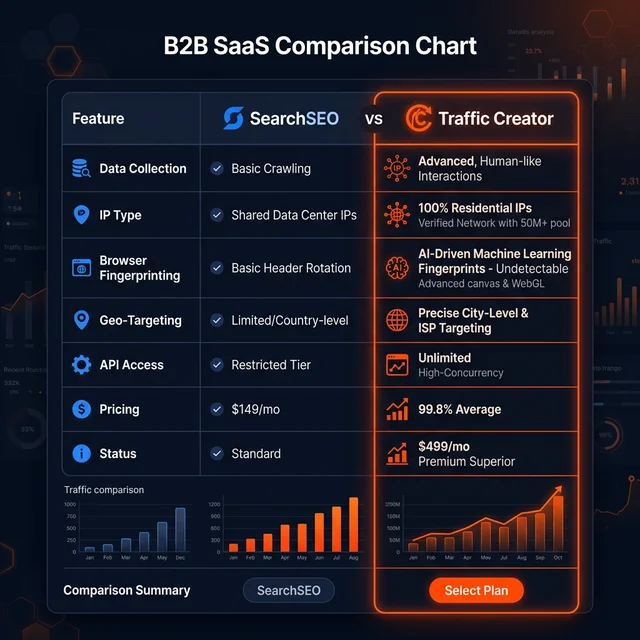
A side-by-side technical comparison of data collection, fingerprinting, and pricing.
AI-Driven Hardware Fingerprinting
Traffic Creator solves the hardware mismatch flaw inherently found in older platforms like SearchSEO. When you configure a campaign in Traffic Creator to originate from a Safari browser on iOS, the Modus Engine injects custom WebGL and Canvas hashes at the driver level that perfectly mirror native Apple hardware.
If Google runs a heuristic check via JavaScript execution on the landing page, the bot returns precisely what a human user's device would return. There are zero mismatched footprints. Consequently, 100% of Traffic Creator's hits pass cleanly into Google Analytics 4, appearing seamlessly as generic organic visitors.
Quality Verification Checklist
4 non-negotiable checks to perform before buying traffic
Verify that 100% of the purchased visits actively register in your GA4 Real-Time dashboard.
Use a tracking link to identify the origin IP ASN. It must be Comcast/Verizon, not DigitalOcean.
The bot must click internal links and travel to secondary pages, ensuring bounce rates hover under 50%.
The engine must explicitly avoid interacting with iFrames loaded from adsense.google.com to prevent bans.
Performance Showdown: CTR Manipulation Efficacy
The SearchSEO Approach
When SearchSEO conducts a CTR manipulation task, the headless browser opens Google, types in your target keyword, and searches for your domain URL. However, immediately after finding and clicking your site, SearchSEO bots typically sit on the landing page for a brief duration and then close the window.
Because they rarely interact heavily with the rest of your site architecture, they naturally incur high Bounce Rates. In the eyes of Google’s algorithm, a user searching for a keyword, clicking a result, and leaving shortly after without navigating further signifies "Pogo-Sticking." This is a negative ranking signal indicating the content did not satisfy the user intent.
The Traffic Creator Modus Engine
Traffic Creator executes an entirely different programmatic sequence aimed at maximizing the value of every single hit.
- The Target Query Search: The residential node queries Google for the exact keyword, utilizing a randomized typing speed algorithm.
- The Pogo-Stick Emulation (Competitor Sabotage): The bot explicitly clicks the competitor currently ranking at Position 1, stays on their page for only 3 seconds, and immediately hits the "Back" button to return to the SERP. This sends a catastrophic negative engagement signal to the competitor's domain.
- The Target Dwell Phase: The Modus Engine then clicks your domain.
- Deep Architecture Navigation: Immediately upon landing on your page, the bot initiates random scrolling motions. After 45 seconds, it identifies a native internal
<a>text link inside your article, clicks it, and travels to a secondary page on your domain. - The Long Session Outro: The bot will then dwell on that secondary page for an additional two minutes before gracefully closing the connection.
This complex flow directly manipulates three crucial Google ranking signals simultaneously: It increases your raw CTR, it actively lowers your competitor's Dwell Time via Pogo-Sticking, and it drives your own domain's bounce rate aggressively downward while keeping Session Durations over 3 minutes.
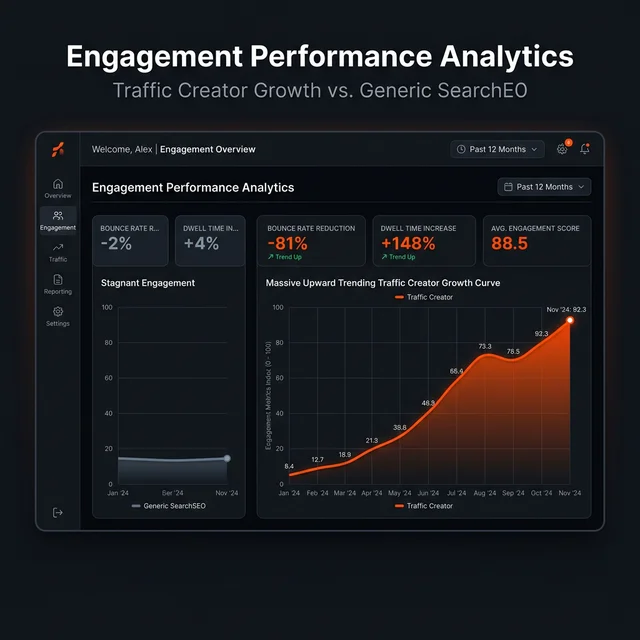
A direct comparison of engagement analytics reflecting basic tool stagnation versus residential growth trajectories.
Is SearchSEO or Traffic Creator Safe for Google AdSense?
This is the single most critical differentiating factor for publishers monetizing purely via display ads.
SearchSEO operates headless arrays that do not inherently block outbound iFrame rendering. If a headless browser loads a page, and an AdSense auto-ad executes heavily in the viewport, an accidental algorithmic click or an unusually high number of ad-impressions from identical underlying datacenters can instantly trigger an "Invalid Traffic Warning" from Google AdSense. Google aggressively bans publishers for this offense.
Traffic Creator inherently builds Ad-Safety into the core architecture of the residential nodes. Before a page begins rendering visually, the Modus Engine utilizes a domain-level firewall blocklist containing all major Ad Network CDNs (Google AdSense, Mediavine, AdThrive/Raptive, Ezoic).
Because the ad scripts are fully blocked at the network level by the bot itself, the advertisements physically never load during a simulated session. If the ads never load, an impression is never registered with Google AdSense, ensuring your Ads CTR remains perfectly organic and your monetization account is never exposed to invalid traffic flags. It is mathematically the safest methodology possible.
Comparing Advanced Features
Conclusion: Which Is Right For Your Strategy?
If you are operating a "burner" site—a rapidly deployed web property intended simply to blast low-quality affiliate links temporarily before burning out—older tools like SearchSEO or ClickSEO may suffice simply due to lower budget thresholds.
However, if you depend on organic visibility for a high-budget SaaS application, a corporate enterprise lead generation site, or an established localized service business, employing easily-detectable datacenter traffic is an existential risk to your domain. The Google anti-spam algorithmic penalties incurred are profound and notoriously difficult to reverse.
For those executing True "White-Hat" Behavioral Tuning, deploying Traffic Creator is unequivocally the safer, more sophisticated methodology. The premium cost directly funds the procurement of Tier-1 residential ISP data connections, ensuring your synthetic engagements are geometrically indistinguishable from organic customers.
FAQ
What does CTR manipulation actually do?
Click-Through Rate (CTR) manipulation tricks search engine algorithms into believing humans highly prefer your specified result over others. If your page ranks at Position #8, but receives 40% of all user clicks for that search term while the #1 result receives only 10%, the algorithm naturally adjusts and elevates your URL to the top position to better serve the user base.
Is buying organic traffic safe for my website?
Yes, but exclusively if the acquired traffic utilizes authentic Residential IPs that mimic human hardware identifiers to perfection. Buying cheap datacenter traffic results in immediate analytics filtering and presents a severe risk of a manual penalty action from Google's Webmaster Team.
Why is SearchSEO traffic not showing up in my Google Analytics?
Google Analytics 4 integrates an aggressive "Known Bot Filtering" heuristic model. If an incoming visitor has a mobile device's User-Agent string but lacks appropriate Mobile Safari rendering execution profiles or possesses a datacenter IP, GA4 automatically silently discards the session to maintain data integrity.
Does Traffic Creator work better than SerpClix?
SerpClix utilizes crowd-sourced manual human clicks, functioning essentially as a micro-task network. While authentic, the problem lies in high bounce rates and geographic inconsistency. Because SerpClix workers are paid pennies per click, they rarely stay on your site long enough to register high Session Dwell Times. Traffic Creator automates lengthy 3+ minute multi-page navigations that manual task-workers will not willingly perform.
Will Traffic Creator click on my affiliate links or Ads?
No. High-quality automated bots like Traffic Creator are specifically designed to isolate their navigation patterns strictly to internal, same-domain hyperlinks. Furthermore, they are coded to blacklist rendering from major ad networks, ensuring your monetization strategies remain completely untouched and purely organic.
Can I test Traffic Creator before committing to a paid plan?
Yes. We encourage absolute verification of our residential architecture. You can sign up natively for a Free Trial and run a live campaign delivering up to 6,000 verified residential sessions to monitor physical changes in your GA4 Real-Time dashboard without entering billing information.
Finalizing Your SEO Deployment Strategy
The differences between the two bot engines boil down to architectural sophistication. SearchSEO was highly effective in an older era of the Internet where crude proxy rotation could fool basic crawl engines. In 2025, deploying such basic techniques against an intelligence entity the size of Google is actively detrimental.
Ready to Experience True Residential Traffic?
Eliminate ghost clicks and avoid AdSense bans. Route your campaigns through verified residential ISPs dynamically.
Claim Your 6,000 Free Hits →Last updated: March 2026 | By Martin Freiwald