An AI video script framework should make a useful idea easier to understand, not manufacture virality. The practical model in this guide turns one audience problem into a clear promise, hook, context, proof, payoff, and next step. It works as a planning system for TikTok, YouTube Shorts, Reels, and longer videos, while leaving factual review, rights, disclosure, and final editorial judgment with a person.
Updated 8 September 2026 · Reviewed by Martin Freiwald
Short answer: A retention-first AI script works in five beats: open with the payoff, state the stakes, deliver the substance in short self-contained sections, remove every sentence that does not advance the promise, and close with one clear next step. Write it for the moment a viewer decides to stay. Then check the result where retention is actually reported — YouTube Studio shows average view duration and where people leave.
Key takeaways
- Open with the payoff, not the preamble — the first seconds decide whether the rest is watched.
- Keep sections short and self-contained so a viewer who joins late still follows.
- Cut every line that does not advance the promise you opened with.
- Judge the result in YouTube Studio: average view duration and the exact drop-off points.
Key takeaways
- Start with one audience problem and one defensible promise; do not ask AI to invent a topic and a claim at the same time.
- Write the hook after the proof is known, so the opening matches what the video can actually deliver.
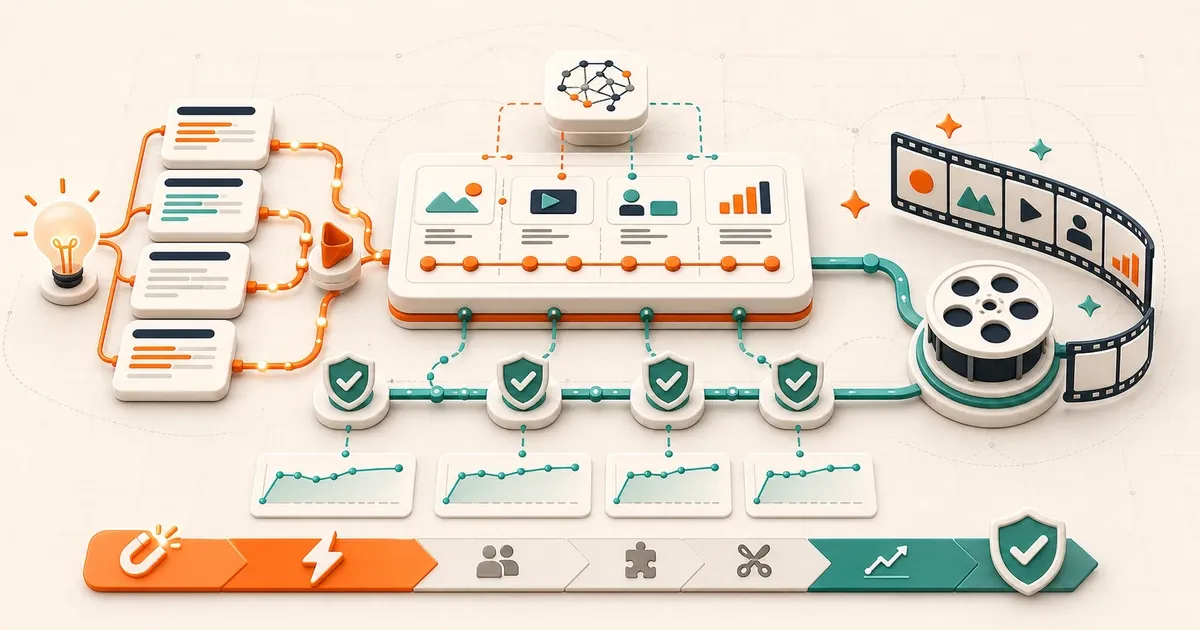
- Use a seven-block script: audience promise, hook, context, proof, progression, payoff, and next step.
- Judge scripts with retention and qualified-outcome data, not views alone or an isolated viral result.
- Use three meaningful variants over 14 days as an operational pilot, not as a universal sample-size or causal-significance rule.
What is the seven-block AI video script framework?
The framework is a sequence for turning research into a video that earns continued attention. It does not predict distribution. TikTok and YouTube personalize recommendations around viewers, context, and observed behavior, so no wording formula can force reach. The framework instead controls what a team can control: relevance, clarity, evidence, pacing, continuity, and measurement.
| Block | Question it must answer | Useful output | Failure signal |
|---|---|---|---|
| Audience promise | Who is this for, and what will they understand or do? | One specific, supportable outcome | The promise could apply to anyone |
| Hook | Why should the intended viewer continue now? | Problem, contrast, question, or demonstration | The opening overstates the evidence |
| Context | What must the viewer know before the proof makes sense? | Minimum necessary setup | A long introduction delays the useful part |
| Proof | What makes the claim credible? | Demonstration, source, example, or limitation | The script substitutes confidence for evidence |
| Progression | What changes from beat to beat? | Steps, contrasts, reveals, or decisions | Several sentences repeat one point |
| Payoff | Does the video deliver what the hook implied? | Answer, result, checklist, or decision | The ending introduces a different promise |
| Next step | What useful action follows? | Try, compare, save, watch, or visit | The CTA asks for an unrelated action |
Research note: this framework was checked against current TikTok Creative Center and YouTube Help documentation retrieved on July 15, 2026. Platform guidance changes, and examples from advertising do not automatically transfer to every organic format. Use the sources as operating constraints, then validate the script with your own audience data.
Copy-ready seven-block script template and example
Copy the labels below into a brief, replace every bracketed field, and delete any sentence the footage or source material cannot support. This worked example uses a hypothetical analytics tutorial; the numbers are labels for scenes, not performance claims.
- Audience promise: “For a marketer seeing campaign clicks but no conversions, this video shows three checks that separate a tracking problem from a landing-page problem.”
- Hook: “Clicks without conversions? Check these three signals before changing your campaign.”
- Context: “We will inspect the event, the session source, and the destination page; this does not diagnose sales quality by itself.”
- Proof: Show the live test event, its campaign parameters, and the matching landing-page request. Label the account, date, and test condition on screen.
- Progression: Check 1 confirms collection, check 2 confirms attribution, and check 3 tests whether the page can complete the intended action.
- Payoff: “If the event and source are correct but the page fails, fix the page. If collection fails, repair measurement before judging the campaign.”
- Next step: “Save the checklist and run it on one controlled test session.”
AI prompt: “Using only the verified brief and evidence below, draft these seven blocks for [viewer], [problem], and [format]. Keep every limitation. Mark unsupported statements as [NEEDS SOURCE]. Produce three hook variants without adding numbers, urgency, or promised results.” A reviewer should be able to trace every factual sentence back to the brief or remove it.
How do you define an audience promise before prompting AI?
Write a one-sentence brief before opening a model: “For [specific viewer], this video explains or demonstrates [specific outcome] using [available proof], without claiming [known limitation].” This separates research from generation. If the team cannot complete the sentence honestly, it is not ready to draft.
Use actual audience evidence: support questions, search queries, sales objections, comments, retention drops, and recurring tasks. YouTube’s content-planning guidance recommends grouping content by format, intended audience, topic longevity, and production cost, then looking for patterns across a meaningful period. The TikTok Creative Center overview describes regional examples and keyword insights, but examples should inspire a hypothesis rather than be copied as a universal formula.
Ask AI for five promise variants, then reject any version that broadens the audience, invents a result, removes a limitation, or cannot be demonstrated in the planned footage. The selected promise becomes the acceptance test for every later block.
How should you write a hook that matches the video?
A hook is a compact reason for the right viewer to continue. It may name a costly mistake, show the result first, ask a specific question, or create a contrast. It should not withhold essential context, impersonate urgency, or promise a result the body cannot support. TikTok’s official creative guidance describes the opening as a hook connected to the message and key narrative; its five creative tips add practical opening guidance for ads. YouTube’s key-moments retention guidance similarly says a stronger intro often matches the expectation set by the title and thumbnail.
Draft the body and proof first. Then ask AI to produce hook variants constrained by the same claim. A useful prompt is: “Write five openings under 18 words. Each must name the audience problem or show the proof. Do not add numbers, urgency, or outcomes not present in the brief.”
- Problem hook: name the obstacle in the viewer’s language.
- Demonstration hook: show the before-and-after state without hiding conditions.
- Question hook: ask a question that the next beat immediately begins to answer.
- Contrast hook: compare two approaches when the distinction is real and useful.
How much context belongs before the main value?
Include only the information required to understand the proof. Creator biography, brand history, and general market commentary can wait unless they establish necessary credibility. A useful editing test is to remove the first sentence and ask whether the demonstration still makes sense. Continue until one more removal would create confusion.
For short-form video, context is often one sentence, one label, or one visual. For a longer tutorial, context can include prerequisites and boundaries. The goal is not maximum speed; it is minimum friction. If a technical video requires setup, say what the viewer needs and why before starting the steps.
What counts as proof inside a short video script?
Proof is anything that lets a viewer examine the claim: a live demonstration, screen recording, cited source, calculation, product limitation, comparison condition, or clearly labeled personal example. Testimonials and AI-generated scenes are not substitutes for evidence. If the result depends on account type, region, budget, sample size, or an edited sequence, disclose that condition near the claim.
Use AI to organize verified material, not to fill missing evidence. Provide the source notes and ask the model to map each claim to a source or mark it unsupported. For measurement content, the Google Tag Manager and GA4 testing guide helps separate a tracking result from a business result. The traffic-quality evidence checklist shows how to distinguish recorded activity from qualified value.
How do progression and pattern changes support retention?
Progression means each beat changes the viewer’s understanding. It can move through steps, compare options, reveal constraints, or answer a sequence of questions. A pattern change is useful only when it marks that movement. Random zooms, sound effects, and captions can add noise without making the argument clearer.
Read the script as a list of beats. Label what changes after each one. If two consecutive beats have the same job, combine them. If a visual is planned, write what it proves rather than merely “add B-roll.” This gives an editor a reason for every cut.
YouTube’s key-moments report documentation distinguishes flat segments, gradual declines, spikes, and dips. A spike can indicate interest or confusion; a dip can indicate skipping or abandonment. Treat the graph as a diagnostic prompt, then inspect the corresponding beat before rewriting it.
How do you write a payoff and CTA without breaking trust?
The payoff resolves the opening promise. Restate the decision, show the completed result, or give the checklist the viewer came for. Do not save the essential answer for an external link. A CTA should be the next useful action after the payoff: test the method, compare two variants, save the checklist, watch the next lesson, or visit a relevant tool.
Match the CTA to intent. An educational viewer may be ready for a related guide, not a purchase. A product evaluator may need pricing or a controlled trial. If the campaign aims to create website action, use the website conversion measurement guide to define the outcome before scripting the CTA.
How should one script change across TikTok, Shorts, and longer YouTube videos?
Keep the audience promise and proof stable, then change pacing, context, and interaction for the format. Do not post one identical export everywhere and assume that platform labels alone create a native experience.
| Format | Opening test | Body emphasis | Measurement priority |
|---|---|---|---|
| TikTok or Reels | Does the first beat identify the viewer or show the result? | Fast progression, readable captions, platform-appropriate sound and disclosure | Hold, completion, saves, comments, profile actions, qualified clicks |
| YouTube Shorts | Does the opening match the title and visible first frame? | One complete idea with a payoff that works without a description click | Engaged views, watch time, audience retention, repeat viewing, next-video action |
| Longer YouTube video | Do the first 30 seconds confirm the title and thumbnail promise? | Prerequisites, chapters, deeper proof, limitations, and a connected series | Intro retention, top moments, dips, average view duration, qualified outcome |
YouTube’s recommendation-system guidance says the system follows what viewers choose and enjoy rather than a creator-facing “algorithm trick.” Its performance FAQ also recommends sustainable quality and experimentation. Use platform differences to improve service to the audience, not to disguise repeated content.
How should a team use AI in the scripting workflow?
Give the model bounded tasks: cluster research notes, propose hook variants, shorten context, identify repeated beats, generate counterarguments, or convert a verified outline into a first draft. Keep source collection, factual approval, rights, consent, disclosure, and publication authority with named people.
- Store the audience evidence and source links with retrieval dates.
- Write the promise and excluded claims.
- Ask AI for alternatives within those constraints.
- Map every factual claim to proof or remove it.
- Review likeness, voice, music, footage, disclosure, and platform policy.
- Approve the exact version, account, caption, and CTA before publishing.
Do not ask the model to imitate a living creator, fabricate a testimonial, hide synthetic media, or operate deceptive account networks. The workflow can accelerate editing decisions; it cannot transfer accountability to the model.
How do you score a script before production?
Use a 100-point scorecard as a rejection tool, not as a prediction of views. Set a minimum score before filming and document why any exception is approved.
| Area | Points | Pass condition |
|---|---|---|
| Audience relevance | 20 | One identifiable viewer problem expressed in audience language |
| Promise and hook alignment | 15 | The opening implies no more than the video delivers |
| Evidence | 20 | Material claims have a demonstration, source, or clear limitation |
| Progression | 15 | Every beat changes understanding or advances the task |
| Payoff | 10 | The stated promise is resolved inside the video |
| Rights and policy | 10 | Consent, licenses, disclosure, and account controls are reviewed |
| Measurement | 10 | Retention and one qualified outcome are defined before publication |
For channel comparisons, the traffic-channel comparison helps keep organic discovery, paid placement, and controlled test traffic separate. App teams can adapt the planning model from the mobile-app traffic guide.
How do you run a useful 14-day script test?
Scope: 14 days and three variants are a manageable pilot window for learning whether the workflow is usable. They are not a universal minimum sample, an A/B-test significance threshold, or evidence that a script caused an outcome. A high-stakes causal claim needs a separately designed experiment with sufficient observations and controlled exposure.
Choose one repeatable topic and create three materially different script variants: problem-first, proof-first, and question-first. Keep the underlying promise, evidence, production quality, account, and offer as stable as practical. Publish across a schedule that the team can sustain. Do not call a test controlled if topic, audience, distribution, and creative all changed together.
Record production time, approval corrections, publication result, retention shape, saves, comments, profile actions, qualified clicks, and the defined business outcome. Use medians and inspect the actual retention moments. A winning hook with a weak payoff is not a reusable win.
Stop if a variant requires an unsupported claim, undisclosed synthetic media, unclear rights, or a misleading CTA. At the end, keep the block that improved both viewer behavior and qualified outcomes without increasing correction or policy risk.
Frequently asked questions
Can an AI script make a video go viral?
No. AI can help structure and revise a script, but it cannot promise distribution, views, retention, followers, leads, or sales. Platforms personalize recommendations, and audience response depends on the topic, execution, context, and viewer.
What is the best hook formula for short-form video?
There is no universal formula. Start with the intended viewer’s problem, a relevant contrast, a specific question, or visible proof. The hook should match the body and payoff. Test meaningful variants against retention and qualified outcomes.
How long should a TikTok or Shorts script be?
Use the shortest length that delivers the promised value with enough context and proof. Platform guidance does not establish one ideal length for every audience. Review retention, watch time, completion, and the result the video was designed to support.
Should AI write the complete video script?
AI can produce a first draft when it receives a verified brief, sources, constraints, and examples. A person should approve facts, originality, rights, consent, disclosure, tone, CTA, and the exact version sent to the publishing account.
Which metric should decide whether a script worked?
Use retention together with one predefined qualified outcome. Views alone cannot show whether the intended audience understood, trusted, or acted on the message. Inspect top moments, dips, saves, comments, qualified clicks, and the relevant business result.
Sources and methodology
This article synthesizes current platform documentation into an editorial workflow; it does not claim that an advertising example or retention pattern will transfer to every organic video. Sources were retrieved and checked on July 15, 2026. Recheck platform features, metric definitions, and policy requirements before using the framework.
- TikTok for Business: About Creative Center — retrieved July 15, 2026.
- TikTok Creative Center: Creative Guidance — retrieved July 15, 2026.
- TikTok Creative Center: Five Creative Tips — retrieved July 15, 2026.
- YouTube Help: Understand Engagement — retrieved July 15, 2026.
- YouTube Help: Key Moments for Audience Retention — retrieved July 15, 2026.
- YouTube Help: Recommendation System — retrieved July 15, 2026.
- YouTube Help: Learn What Content to Create — retrieved July 15, 2026.
- YouTube Help: Performance FAQ — retrieved July 15, 2026.
Editorial disclosure: Traffic Creator is not affiliated with TikTok, YouTube, or the editing tools discussed. Framework choices and recommendations are editorial judgments based on audience relevance, evidence, reviewability, measurement, and policy risk.
Try Traffic Creator free
GA4-visible traffic, credits that never expire, 195+ countries — start with 2,000 free visits, no credit card.
Start Your Free Trial →Check retention where it is reported
Choose your countries and watch behaviour, credits that never expire - start free, no credit card.
Start free →